Nutrition
Fueling For A Race
Generally, activities shorter than 90 minutes do not require additional fueling.
Before the Race Day
The Mayo Clinic currently recommends that you consume 8 to 12 grams per kilogram of body weight of carbohydrate per day in the two to three days prior to their event, while resting or significantly dialing back their training.
On the Race Day
On the race day, it suggests targeting 2 to 4 grams of carbs per kilogram of body weight two to four hours prior to your race. (some also recommended 0.5 gram for per pound, which his effectively 1 gram per kg).
Then, 15 minutes before the start, eat either a couple Medjool dates or a gel.
Generally, multi-day carb loading isn't necessary for training. But long-runs can be a perfect opportunity to practice race-day carb loading to make sure your body is comfortable with the type of food and schedule.
The infamous "wall" describes the depletion of carb reserve, which is often observed in marathon runners in the last 6.2-mile (out of the total 26.2 miles). [1] suggests that top form human body can carry energy to perform as maximal aerobic capacity for 90-120 minutes, though practically it is never close. As a result, continuous fueling during the race has been critical for the elites.
However, our body has limited intake capacity, especially during race where water is a limited resource. So typically, smaller and frequent feeding is preferred, while keeping the body hydrated is also crucial.
Note, carb intake typically has little impact of the first 60-minute performance, while it also takes time for the fuel to reach the muscle.
[1:1] provided a sample fueling/drinking schedule. Note that the latter stages of the race, however, have less focus on simple hydration.
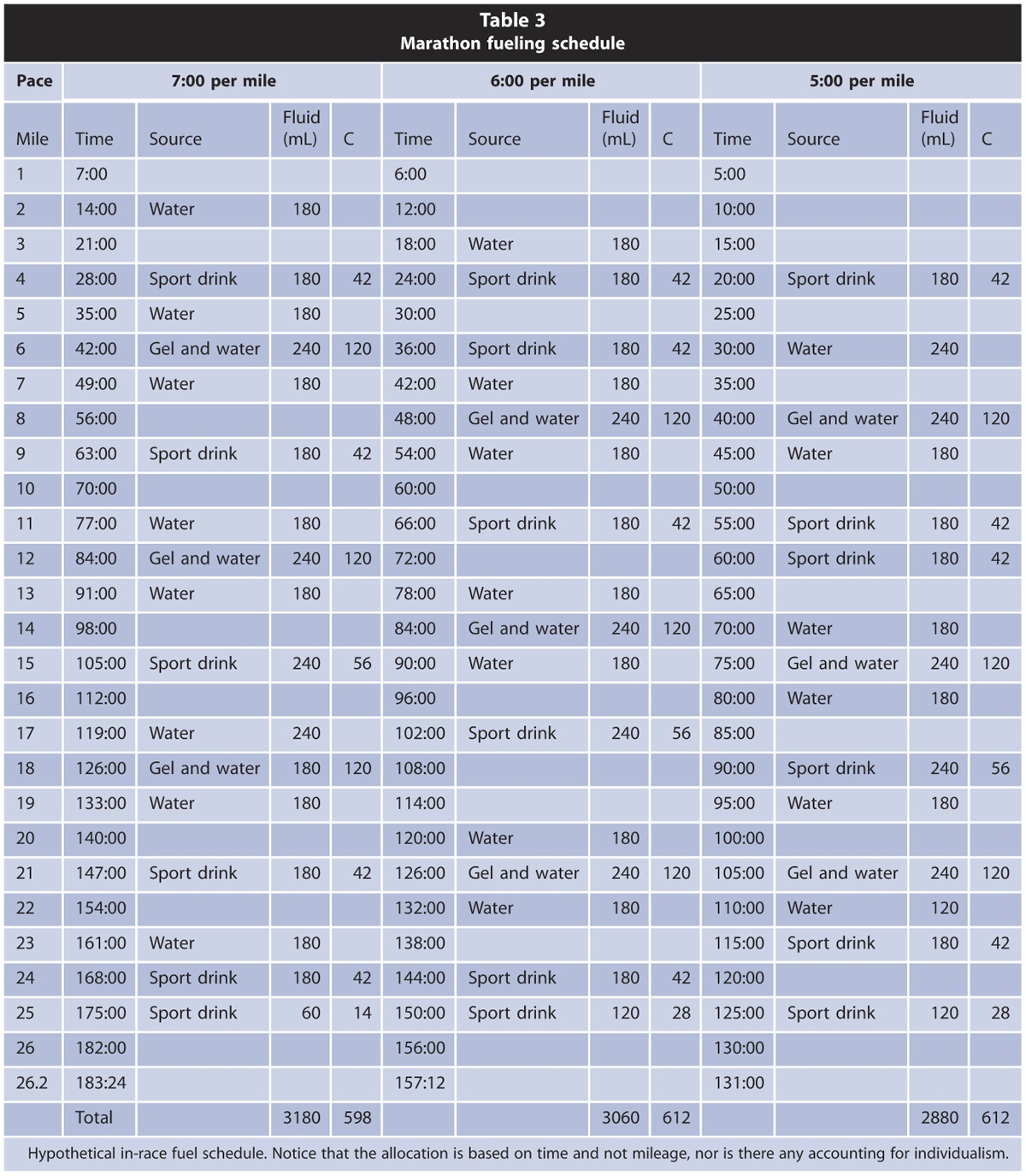
Don't swallow a gel all at once. Take time - e.g., between a quarter and one mile of running distance. Taka a little of the gel at a time.
Fat vs Carbohydrate
Fueling sources during endurance running is often split into fat and carbohydrate for simplicity.
The big differences are:
| Fat | Carbohydrate | |
|---|---|---|
| Utilization | Hard - only aerobically and requires more oxygen. Slow - two times longer than carb metabolism |
Easy, both aerobically and anaerobically |
| Reserve | A lot (up to ~2000h @ 60% VO2Max) | Limited: Muscle glycogen can provide ~2h of energy Liver stores ~20% of body's glycogen |
| Absorption | Slow - almost impossible during a race | Quick - possible during a race |
The good news is our body can be trained to improve fat utilization (for example, by high fat diet, and/or exercise with low carb reserve). The bad news is that our carb efficiency may drop while doing that. Basically, the metabolism of the two sources compete with each other on limited resources such as oxygen, water, blood PH level and entry into mitochondria.
Fasted Training - Debate in Stress vs Performance
There is a debate that while training with low carb to improve fat efficiency, our body is likely not at its peak performance state. As a result, our body can't get as much as stimulus from the training. If we really want to push to train at high level, a high risk of injury is another concern. For females, such training may impact worse hormone balance more[2].
Nowadays, athletes can get enough carb fueling during a race without much difficulty, so fat-efficiency oriented training is not that attractive for most people.
(See [3] for details.)
Timing And Proteins
The following is some note from reading fellrnr and [4]. My main takeaway is to pay attention to the role of protein and recovery.
Pre-Exercise
2-4 hours before exercise, ingest 150g~200g of carbohydrate, to increase muscle glycogen.
Note - unless you want to deliberately training your body in the state of depletedd glycogen, sufficient carb is crucial for a quality training session, and avoid injury.
Though there is a concern that near-exercise carhobydrate (30-45min before exercise) may trigger things like insulin spike, but [4:1] found few studies supporting that.
During Exercise
Interesting knowledge:
-
Skeletal muscles stores about 30~500g glycogen, the liver stores 60~100g, while only 15~20g glucose are in blood[4:2]. For those care about blood sugar level, muscles are very important blood sugar level stabilizer.
-
Exercising at 70~75% Vo2max will consume more glycogen than our body can take externally during exercise, while during lower-intensity exercise, we can ingest enough to compensate the consumption in real time.
-
Multiple carbohydrate types can improve ingestion during exercise. E.g., dextrose(葡萄糖), fructose(果糖), maltodextrin(麦芽糖糊精). They use different metabolism channels and can be ingested into our body system in parallel.
-
Carbohydrate supplement have significant positive impact of immune system (<=6% beverage).
-
Mixing a small amount of protein (1.2%) with lower amount of carbohydrate (~3-4%) shows a better improvement on endurance (though no impact of peak performance).
- Such supplement have both short-term and long-term benefits on performance, recovery and injury prevention.
Suggestion for ingestion during exercise
- Every 20 minutes, ingest a beverage of 3~6% of carbohydrate, with 1-1.5% of protein.
Post Exercise
The first 45 minutes
The first 45 minutes is critical to recovery:
-
Muscle is starving, and is sensitive to nutrition. It can utilize a large amount of nutrition (carbohydrate and protein) very quickly, while being sensitive to insulin.
- That means the risk of volatile blood sugar level is low.
-
A large amount of carbohydrate or/and protein ingestion can trigger a "super" recovery regime in the body, which keeps the nutrition sensitivity high. Meaning, faster recovery and adaptation. Such elevated state can last for extended period (10 ~72 hours).
-
In the opposite, if inadequate nutrition is provided in the first 1-2 hours, the window for "super" recovery will be closed, and the body will be in a kind of "hibernate" state. Insulin sensitivity will be high, and subsequent nutrition ingestion will be more likely converted to fat instead of being used for muscle synthesis.
Suggestion for the first 45 minutes
(1:4) ration:
- Carbohydrate: 1.0~1.5g per kg body weight
- protein: 20-30g
Above is the suggestion for intense workout. For light to moderate workouts, we can consider to half the ingestion amount.
2-6 hours after the exercise
If sufficient nutribution is provided immediately after the exercise, and the body is in the "super" recovery state, more nutrition can be utilized in the next several hours. [4:3] suggested 6 hours, and there are studies suggesting benefits from longer window.
[4:4] also suggested taking supplement nutribution every 2-3 hours, mostly due to the limitation of protein digestion/metabolism. However, there is also some new study suggesting one large protein ingestion can have benefit longer than the 2-3 hours window.
Suggestion for the 2-6 hours (or more) after exercise
If possible, take 1:1 ratio every 2-3 hours:
- 12g protein
- 12g carbohydrate
(total ~100 kCal)
Fast vs slow protein
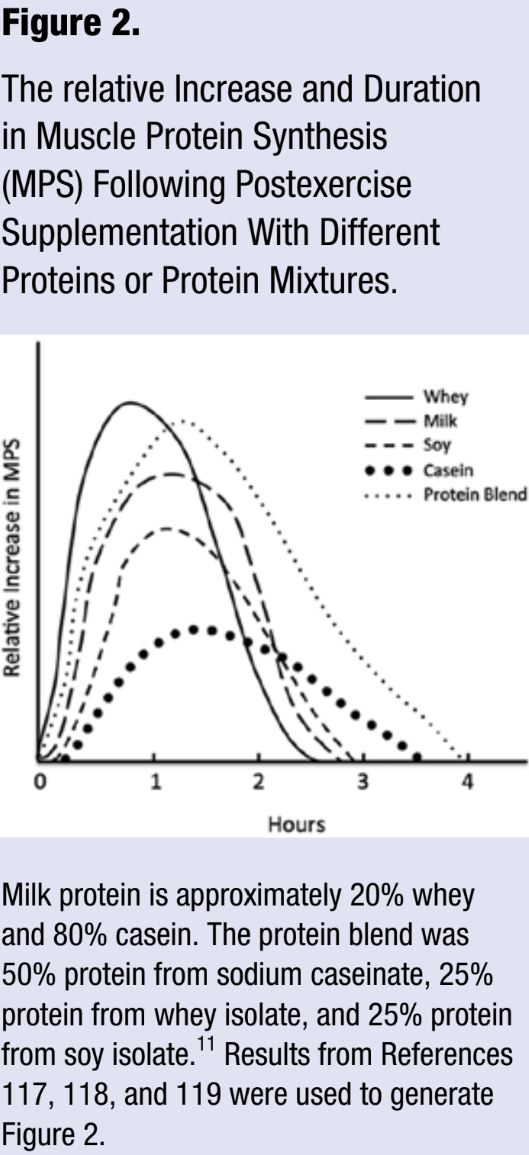
The figure below ([4:5]) shows the timing of protein synthesis post exercise:
- Whey is the fastest protein - so ideal for the first 45 minutes immediately after exercise.
- casein is the slowest - good for later recovery
- Milk is 20% why and 80% casein, though still have the relatively fast timing. Probably the whey portion is making it to the synthesis process.
- Given it is very accessible, it is good supplement for everyone.
- Though to achieve the significant amount (e.g., 20g), you will need 2-3 glesses of milk.
- Though not in this diagram, egg white is also considered as a fast protein, similar to whey.
- With a lot of fat, whole egg will be much slower to digest. USDA has its contents.
Reference
Marathon Fueling Techniques: Physiologic Understanding and a Proposed Intake Schedule. ↩︎ ↩︎
Fasted Training May Have Long-Term Risks, Especially For Female Athletes. ↩︎
Fuel for the Long Run: The Science of Different Fuel Sources ↩︎
Nutrient Timing: The Means to Improved Exercise Performance, Recovery, and Training Adaptation ↩︎ ↩︎ ↩︎ ↩︎ ↩︎ ↩︎