Injuries
Overall Approach
Honestly, I have been many injuries myself, and my approach is always to put my body's message before everything else.
- Be sensitive and cautious
- Stop at any median level discomfort
- Test, diagonize, evaluation before return to normal training
- Be sensitive
- Short-term
- Fix the symptom/pain through rest (or/and anti-inflammation drugs with professional instruction).
- Inspect and fix external factors, such as shoes.
- If it is related to over-training, adjust training plan.
- Use equipments to reduce the pain and help body to heal.
- Long-term
- Identify the root cause (e.g., bad forms, muscle imbalance/inflexibility/weakness).
- Fit in cross training with focus on mitigating the root cause (e.g., strength/stability training, stretching).
- Strong runners are much less likely to get injuries. So don't be afraid of weight training.
- Consider more warm-up/cool-down, and/or active recovery (e.g., massage/icing).
- Consult professional (e.g. physical therapist)
Top Concern
For any runner, injury prevention should be the top priority!
This is not only for general health concern. Injury is probably the top factor that impacts runners' performance and training.
Causes
Training error
Over-training andd insufficient recovery probably contributed to majority of runners' injury.
Remediations:
- Start with a good plan
- Listen to your body's recovery – adjust frequently while keep the big goal. Let go the ego.
- Stick to a "dynamic" plan – don't over train within the plan
Flexibility
This is can be controversial. In general, inflexibility increases the chance of injury, but often not the direct cause.
Remediations:
- More warm-up/cool-down (note, DO NOT over-do it)
- stretching
- Cross training
- Also, improve muscle balance
Strength (and flexibility)
Interestingly, strength and flexibility is naturally conflicting in our body. A heavily trained muscle group is often stiff, which is human body's way to improve its strength.
Stretching, which is believed to improve flexibility, also reduces the body's effort to make the muscle stronger.
You will need to find a balance in pursuing the two - strength vs flexibility.
Muscle imbalance
Muscle imbalance often leads to muscle fatigue during training, which increases the chance of injury.
Remediations:
- Cross training
- Drills
- Improve flexibility
Bad form
It is challenging to change the forms by oneself. Interesting, pros also have various forms if you observe carefully. It is not saying forms are not important. Rather, human body's great adaptation over one's life time can make everyone's form specific to itself.
Remediations:
- Try gradual change, do not force dramatic changes
- Drills
- Self video taping
- An interesting video channel
Footwear
It might be the hottest topic everyone cares. But, I don't believe too much in the shoes' mysterious mileage limit. I'd rather pay attention to how it feels on my feet everyday.
Common Injuries
Disclaimer - I am not a professional physical therapist. Rather, I am just sharing what I learned over my research and personal experiences.
Plantar Fasciitis (PF)
PF is a common injury typically in a form of pain in the heel, or bottom of the heel. Often it is the worst in the morning with the first few steps. It is related to overuse of the plantar fascia. That is, *feet are used too much, so that the fascia is used to compensate in place of muscles.
As for treatments, short-term is often to reduce pain and let it heal, while maintain the muscle groups that should have taken the load instead of the fascia. The long-term solution is to progress training slowly while keep the muscle groups strong.
Treatment of Plantar Fasciitis is so far the best reference I have found.
High level
- Identify training errors - Relative rest, apply ice after training and evaluatoin of shoes.
- Shoes - to reduce the load on feet
- Change for wider/larger shoes
- Better cushioned midsole
- Shoes - to reduce the load on feet
- Correct biomechnical factors with stretching and strengthening.
- Stretching - calves
- Strengthening
- Towel curl
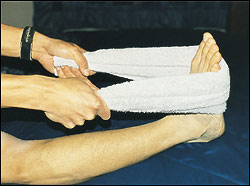
- Toe taps
- Picking up some objects with toes.
- (Preventative) More calves exercise.
- Towel curl
- Running forms
- Land softly reduces the stress.
- Avoid excessive landing on toes or balls.
- If no improvement, consider night splints and orthotics.
- Equipment
- Arch support and orthotics
- Night splints
- Equipment
- If still no improvement, check if professionals for more serioues treatment.
- Drugs (short term)
- anti-inflammatory drugs – results unclear. Ok for short term pain relief.
- Ice 10-15min might help
- Other serious treatments, e.g., corticosteroid injections, surgery.
- Drugs (short term)
Iliotibial Band Syndrome (ITBS)
Symptom - Often pain at hip or outside of the knee.
Causes - irritated iliotibial band (ITB). Often the tightened ITB will cut into the knee, which causes the pain there.
Treatments are similar to PF
- Rest to reduce the on-going pain and inflammation.
- Apply ice or other therapy to speed up recovery.
- Stretch
- Strengthen muscle groups in glute and thigh (e.g., quad, hamstring).
- Improve balance
Achilles Tendon Injuries
Causes - the common cause is over-use.
Treatment
Note, tendon heals very slowly. The way our body heals is to lay down new fibers. However, such newly formed layers can be damaged by excess stretching.
To avoid it, pay special attention to calf stretching/strengthening exercises. You can replace stretching calves with foam roller, or massage.
Avoid low-heel (or low drop) shoes to reduce load on the tendon. Some amount of cushion can be considered as well.
Anterior cruciate ligament (ACL) injury
(Note, this is mostly my notes from the "Resources" section below)
Overview
About 2/3 people suffered from ACL injury can't return to the sports, and many of them develop chronicle issues. Many atheletes suffer from ACL injury since it is one of the most volunerable part of our lower body that bears extreme stress during sports.
There is a recent trend of such injury in young atheletes, possibly indicating increased risk due to new life style or increased competition levels.
Evaluation
A 3 point inspection is proposed by different sources, which focuses on three parts of our body.
- Upper body alignment:
- Ear-shoulder-hip should be in a straight line.
- Chest up. Eye up. Shoulders down, back and even.
- While standing by the wall: heel, hip and back of head should touch the wall. Standing tall.
- Middle body alignment / core control:
- Pelvis(waist line) should be horizontal, when viewed from front and side. Maintain horizonal pelvis while performing different positions:
- Lower to the quarter squat position (thigh 45 degree, arms straight forward)
- To find the right position, tilt pelvis back and force, to find a natural position.
- For Anterior pelvis tilt (tilt too much forward):
- Ribs down, belly button towards spline
- For posterior pelvis tilt (tilt too much backward):
- Chest up, arch lower back
- (Stability) Make sure can maintain such position while being pushed lightly on the back.
- Single leg knee up stand
- Plank – spine in neutral position
- Lower to the quarter squat position (thigh 45 degree, arms straight forward)
- Pelvis(waist line) should be horizontal, when viewed from front and side. Maintain horizonal pelvis while performing different positions:
- Lower body alignment:
- Hip-knee-ankle in a straight line, when viewed from front
- Knee cap over pinky toe
- Maintain such alignment while in different positions and movements:
- Quarter squat
- Running forward (both knees should be in alignment at any time)
- Jumping (jumping jack, squat jump, forward/backward hop)
- Changing direction (lateral jump, run-then-stop, run-then-stop/turn).
Prevention
Fortunately, neuromuscular training is proved to reduce such risk dramatically. Such training should cover all following phases:
- Movement prepare
- A/B/C Skip - keep all 3 points in the right positions
- Core control
- Plank (standard, side)
- Superman position
- Single leg knee up (or touch the heel with hand), while maintaining the 3 points.
- Lower body strengthening
- Lounge
- Standard squat
- Single leg squat
- Toe up
- Jump
- Jump and landing
- Double leg hop (left and right)
- Scissor jump (lounge, jump, switch legs and land).
- Squat jump
- Start from standing position
- Small hop to the quarter squat position, make sure to check all the 3 points
- When landing, move hip slightly backwards to absorb the shock, and land softly on the balls of the feet
- Arms forward to keep balance
- (advanced) Vertical/forward jump, and back down to the squat position
- Cues – hip back, chest up, eye forward, land softly
- Change speed and direction
- Run forward and stop
- Lower center of gravity
- Move/run forward
- Widen the base of support (leg spread out wide)
- 3 steps to a full stop
- (Mutation) 3 steps to a full stop with 90-degree turn. In this case, the exerior leg bear more force.
- Snake run - run around a series of cones.
- Run forward and stop
HSS provides a greate collection of neromuscular warmups based on skill levels.
Resources
- Prodject Play
- A Guide to Neuromuscular Training
- HSS injury prevention playlist of 30min exercises
- ACL injuery prevension course
- How to Evaluate Your Child's Movement
A Note on Rest
It is a bit contraversial that lying-flat kind of rest is not suggested, since it reduce the muscle and other performance ability quickly, which may not idea for overcoming the symptoms. Rather, controlled exercise is often suggested.
Depending on the severity of the condition, the pain may kick in only after certain distance (e.g. 2 mile of running). So try to run in a moderate pace and stop before 2 miles. You can repeat after some rest. This kind of run-and-rest will allow the muscles some time to rest and recovery, while still being stimulated to perform. Note, don't push it too hard, and it may reduce the speed of recovery.
Another suggestion is to consider other (hopefully related) sports, that can maintain physical conditions while reduce the load on the particular area (foot in this case). So things like cycling and rolling are good options. Actually, many runner may find symptom reduced by simply running on treadmills or rubber running tracks, where the extra cushion from the ground reduces shocks to the feet.